
OK, so: American football training. I have never played organized football, and watching a game does not make me a coach. But I was curious about the mix of strength, short bursts of speed, and quick decisions that players need. When I first tried to copy the hardest drills I saw online, I learned a simple lesson: a useful training plan should fit the person doing it.
This is my practical version of football-inspired fitness for a recreational adult. It covers the qualities I would train, a weekly routine I could actually repeat, and the limits of gym work. If you play on a team, your coach and qualified strength staff should guide your position-specific work.
What Football Actually Asks of the Body
One play may ask an athlete to accelerate, stop, change direction, push against another player, and recover before the next play. The details differ a lot by position. A lineman and a receiver do not need identical workouts, and neither needs a random collection of maximum-effort drills. I find it more helpful to think in four buckets: basic strength, speed and movement skill, conditioning, and recovery.
There is also a part that a gym cannot simulate safely: contact. Lifting weights does not teach tackling technique, and getting stronger does not make a person immune to concussion. I would never use unsupervised collisions as a fitness drill.
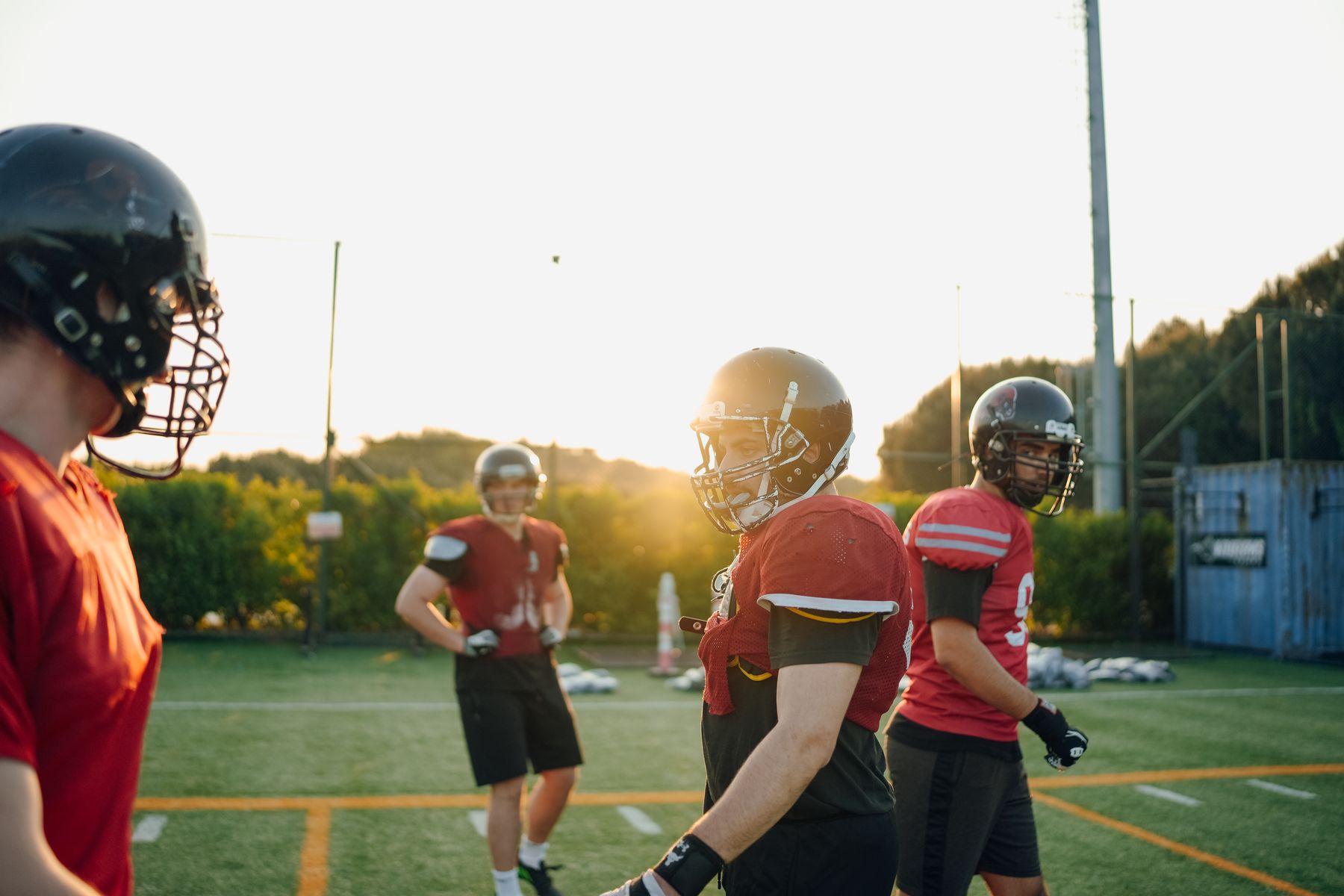
Build Strength Before Chasing Highlight-Reel Power
My first temptation was to start with impressive-looking lifts. That was backwards for me. A simple squat, a hip hinge, a push, a pull, and a carry gave me a much clearer starting point. I could learn the movements, repeat them, and gradually add a little work without turning every session into a test.
Two full-body strength sessions a week are a sensible place to begin. I might do a comfortable squat or step-up, a Romanian deadlift or another hinge, a push-up or press, and a row. Two or three sets of each is enough for a starter session if the last repetitions still look controlled. Equipment can be adjusted to what is available. I do not need a maximal barbell lift to benefit from training.
As a general benchmark, the American College of Sports Medicine emphasizes training major muscle groups at least twice a week. That is a useful reminder that consistency matters more than finding a magic exercise. I add load only when I can keep the same range of motion and control.
Speed and Agility Start With Braking
Football clips make sprinting look effortless. In practice, a beginner needs space, a gradual build-up, and a way to slow down. I start with easy movement and a few short accelerations at a pace I can control. Then I practice stopping in several steps, rather than planting one foot and trying to make a sharp cut at full speed.
Cones can give a drill a clear path, but they are not the point of the workout. For me, the valuable skill is moving deliberately: accelerate, lower speed, turn, and accelerate again without losing balance. A few good repetitions with plenty of rest teach me more than a long, sloppy ladder session. If I am new to running or returning after time away, brisk walking and easy jogging come first.
Power work can come later. A small, controlled jump or a light medicine-ball throw is easier to learn than a heavy power clean. I keep the repetitions low and stop when landings become noisy or awkward. Olympic lifts can be appropriate with coaching, but they are not required for a recreational football-inspired routine.
Conditioning Without Turning Every Day Into a Sprint Test
Repeated plays involve effort and recovery. That does not mean I need to sprint until I feel sick. I like to build an easy aerobic base first with walking, cycling, or another activity I can sustain. It helps me tolerate training overall and gives me a low-pressure way to move between harder days.
Once that feels comfortable, one short interval session can add variety. For example, after warming up, I can do six rounds of 15 to 20 seconds of controlled faster movement followed by at least a minute of easy movement. Those are not all-out efforts. I finish while I could still perform another round with good form. The exact timing matters less than keeping the session repeatable.
My Simple Weekly Football-Inspired Plan
Here is the schedule I would give myself when getting started. It is deliberately less dramatic than a professional athlete’s week.
- Monday: Full-body strength. Squat or step-up, hinge, push, pull, and an optional carry. Start with manageable weights and finish with clean repetitions.
- Tuesday: Easy walk, bike ride, or rest. If I feel stiff, I keep the movement gentle.
- Wednesday: Short movement session. Warm up, practice several controlled accelerations and stops, then do a few easy direction changes with generous rest.
- Thursday: Rest or an easy aerobic session.
- Friday: A second full-body strength workout. I can use the same patterns and change one exercise for variety.
- Weekend: One comfortable aerobic outing if I want it, with at least one genuinely easy day.
I would use this as a template, not a rulebook. Someone with practice, games, physically demanding work, or an existing running program needs to account for those loads. If my legs are still heavy on Wednesday, I move the speed work or make it an easy walk. Progress is easier to measure over months than over one exhausting week.
How I Progress Without Burning Out
For the first few weeks, I would focus on showing up and learning the movements. Once the sessions feel familiar, I could add a small amount of weight, a repetition, or one extra set to one exercise at a time. On the field, I would increase speed or complexity gradually, not both in the same session. More work is only useful if I can recover from it.
A warm-up is part of each session: a few minutes of easy movement, then simpler versions of what I plan to do. Before a sprint session, that may mean walking, light jogging, and a couple of gentle accelerations. Before strength work, it may mean lighter practice sets. I also leave room for sleep, food, and rest. Persistent pain or unusual fatigue tells me to step back and get appropriate advice rather than force the next workout.
Contact and Concussion Are Separate Safety Issues
For anyone who actually plays football, technical coaching, appropriate equipment, and the team’s safety procedures matter. They cannot be replaced by a stronger squat or a tougher attitude. If a concussion is suspected after a hit, the CDC’s HEADS UP guidance says to remove the athlete from play immediately, keep them out that day, and have a healthcare provider decide when return is appropriate. I would never tell someone to shake off a head injury and continue.
If I only want the fitness side, I can train strength, running, and movement without contact at all. That is a perfectly valid choice. The goal is to borrow useful training ideas, not pretend that a workout makes collisions safe.
What I Would Keep, and What I Would Skip
I would keep the balance: strength twice a week, some enjoyable aerobic work, a little controlled speed practice, and enough recovery to return next week. I would skip the idea that soreness proves progress, that every athlete needs Olympic lifting, or that a single routine can serve every football position. None of those claims helped me train better.
Football-inspired fitness can be fun because it makes training feel athletic and varied. My version is less about surviving a brutal circuit and more about building skills I can repeat. If I leave a session moving well and ready for the next one, that is a better result than being wrecked for days.
发表回复